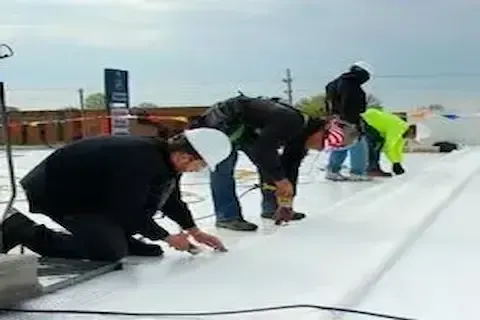
Emergency Leak Repair for Coon Rapids Commercial Roofs
A roof leak in a commercial building does not wait for business hours. When water starts pushing through your ceiling tiles, soaking insulation, or running down interior walls, every minute of delay multiplies the damage. Coon Rapids businesses operating on flat membrane roofs face a particular risk because standing water, ponding seams, and freeze-thaw stress create conditions where a small breach can open wide in hours. Having a local contractor who responds same-day and understands the specific demands of Anoka County commercial roofing is not a luxury — it is an operational necessity.
Why Commercial Flat Roofs in Coon Rapids Are Vulnerable to Sudden Leaks
Flat and low-slope roofs are the standard across Coon Rapids commercial corridors, from manufacturing facilities near Highway 10 to retail strips along Foley Boulevard. These systems rely on continuous membrane integrity to shed water, and that integrity can fail in ways that are not always visible from the ground. Seam separations, punctures from rooftop equipment work, flashing failures around HVAC curbs, and UV-degraded membrane sections all create pathways for water intrusion.
Minnesota's climate accelerates these failure points. The freeze-thaw cycles that hit Anoka County from November through March force moisture that has already entered seam edges to expand and contract repeatedly, widening gaps with each cycle. A seam that merely looks worn in October may be actively leaking by January. When summer arrives, intense UV exposure and heat cycles further stress aged membranes. The combination means flat roof systems in this region age faster than national averages suggest, and emergency situations often develop mid-season rather than at obvious transition points.
What Happens During an Emergency Roof Leak Response
When you call for emergency service on a commercial roof leak, the response should follow a clear sequence. First comes stabilization — stopping active water entry using temporary tarping or emergency sealant application to protect your interior inventory, equipment, and structural components. This is not a repair; it is containment. The goal is to get the water stopped while the building remains operational.
Once the immediate threat is contained, source tracing begins. On a flat commercial roof, the point where water appears on your ceiling is almost never directly below the breach. Water travels along roof decking, insulation layers, and vapor barriers before finding a gap. A thorough inspection walks the entire membrane surface, checking seams, flashings, penetration boots around pipes and conduit runs, and field membrane for blisters or punctures. Drainage outlets and scuppers are checked for blockage that may be creating ponding above the leak zone.
After the source is confirmed, permanent membrane repair restores the system. Depending on the membrane type — TPO, EPDM, or modified bitumen — this involves heat-welded patches, adhesive-bonded repair sections, or torched membrane replacement on the affected zone. Flashings are re-terminated at walls and parapets if separation contributed to the failure. The repaired area is then verified before the crew leaves the site.
Common Mistakes That Turn Small Leaks Into Major Repairs
The most costly mistake Coon Rapids commercial property owners make is treating a roof leak as a maintenance task rather than an emergency. Placing buckets under drips and scheduling a repair for the following week allows water to saturate insulation, which holds moisture against the roof deck and accelerates rot or corrosion depending on deck type. Wet insulation also becomes a mold vector quickly in enclosed ceiling cavities, adding remediation costs on top of roofing costs.
A second mistake is allowing general maintenance crews to attempt repairs using caulk, roofing cement, or consumer-grade sealant products. These materials are not compatible with commercial membrane systems and often cause secondary damage. Roofing cement applied over TPO, for example, can contaminate the membrane surface and prevent proper heat-welded patches from adhering during the actual repair, requiring additional surface preparation and cost. If you need Commercial Roof Repair performed correctly the first time, the materials and methods used matter as much as the speed of response.
Third, property managers sometimes confuse interior ceiling staining with an active leak. Old staining does not always indicate current water entry, but treating it as resolved without inspecting the roof leaves an existing breach open. Moisture mapping of the ceiling area and a roof inspection should happen together to confirm whether the source is active or historical.
Choosing an Emergency Roofing Contractor in Anoka County
Not every roofing company operating in the Twin Cities metro is equipped for true emergency commercial response. When evaluating who to call, the key factors are response time commitment, commercial membrane experience, and familiarity with the building types common to Coon Rapids. Industrial facilities on the north side of the city near the Rum River corridor have different roofing configurations than mid-century retail buildings or newer tilt-up commercial construction. A contractor who has worked across these property types understands what to look for during source tracing and how to match repair materials to existing systems.
Licensing and insurance are non-negotiable on a commercial emergency call. Any crew accessing your roof must carry adequate liability coverage and workers' compensation. Verify both before allowing access. Reputable contractors will provide documentation without hesitation.
For Coon Rapids property owners who want to understand the full scope of what commercial roofing services cover beyond emergency calls, reviewing the details of ongoing commercial roof repair work helps set realistic expectations about both maintenance schedules and cost structures for different repair types.
After the Emergency: Documenting and Planning Forward
Once an emergency repair is complete, documentation becomes your next priority. Photographs of the breach location, repair materials used, and any damage to underlying insulation or decking should be collected immediately. This documentation supports insurance claims and gives you a baseline for future inspections.
Emergency repairs, while designed to be durable, are often partial solutions. A section of seam that failed under stress likely indicates that adjacent sections are approaching the same condition. Scheduling a full membrane inspection within sixty days of an emergency call allows you to identify whether the repair was isolated or symptomatic of broader system deterioration. Coon Rapids businesses that adopt this two-step approach — emergency response followed by planned assessment — consistently see lower total repair costs over a five-year horizon than those who respond only when water is actively entering the building.
Protecting your Anoka County commercial property from roof leak damage starts with knowing who to call and what to expect when they arrive. Having that answer ready before an emergency occurs is the most practical step any property manager can take.
