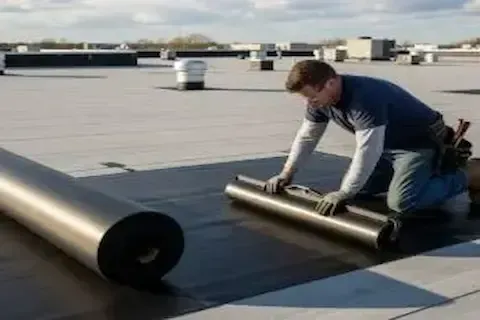
EPDM Seam Adhesive Failures on Coon Rapids Rooftops
Seam failures are the most common source of leaks in EPDM roofing systems, and Coon Rapids commercial properties are no exception. The long lap joints that connect rubber membrane panels hold back enormous volumes of water during Minnesota's heavy spring rains and fall storms. When the adhesive bond at those seams deteriorates, water finds a path directly into the building envelope. Understanding what causes these failures and how they are properly repaired can help building owners in Anoka County make informed decisions before a small splice-line problem becomes a full interior water event.
How EPDM Seams Are Constructed
EPDM membranes are installed in large panels that overlap at their edges. Those overlapping edges, called laps, are bonded using either a contact-style lap sealant or a seam tape system. Factory-applied tape seams rely on a high-tack butyl-based adhesive strip that bonds when pressed under a roller. Field-applied seams use a primer followed by either tape or liquid adhesive to create the bond. The finished lap is typically three to six inches wide and runs the full length of wherever two membrane sheets meet, including perimeter flashings, penetration boots, and field splices across the main roof deck.
When installed correctly and left undisturbed, these laps can hold for decades. The problem is that they are vulnerable to a specific set of stressors that occur routinely on Coon Rapids rooftops.
Primary Causes of Seam Adhesive Failures in Coon Rapids
Minnesota's climate is hard on adhesive bonds. The freeze-thaw cycle that Coon Rapids experiences every winter causes the rubber membrane to expand and contract with temperature changes. EPDM itself handles this movement well, but adhesive bonds at seams are more rigid. Over years of cycling, the adhesive layer can develop microtears that gradually widen until the lap edge lifts.
Beyond thermal cycling, several other conditions accelerate seam failure:
- Age-related adhesive degradation — Older solvent-based adhesives dry out over time and lose their grip on the membrane surface.
- Improper surface prep at installation — If the EPDM surface was not primed or was contaminated with dust or moisture during the original install, the bond never fully formed.
- Ponding water at lap edges — Standing water on a low-slope roof softens adhesive over time, particularly at field splices that run perpendicular to drainage flow.
- Foot traffic — HVAC technicians and maintenance crews walking across a commercial roof in Coon Rapids apply shear stress directly to seam lines whenever they step on a lap.
- Low-temperature application — If the original seams were bonded in cold weather without adequate warming, the adhesive may never have cured to full strength.
What a Failing Seam Looks Like
Seam failures rarely announce themselves loudly. More often, the progression is gradual. The earliest visible sign is usually a slight lifting at the edge of a lap, sometimes called a fishmouthing condition, where the membrane edge curves upward away from the substrate. At this stage the seam may still be watertight, but water is now pooling along the lifted edge every time it rains.
As the failure progresses, the lifted section grows longer. You may notice a slight ripple or bubbling along the splice line when you walk the roof. Eventually, the lap edge separates enough to allow water infiltration, and the evidence shows up inside: staining on ceiling tiles, wet insulation when you probe, or moisture readings on a thermal scan. By the time an interior leak is obvious, the seam has often been leaking slowly for one or more full rain seasons.
Repair Methods for EPDM Seam Failures
The correct repair approach depends on how far the seam failure has progressed and how much of the original adhesive remains functional. For EPDM Roofing seam repairs, there are three primary methods used on Coon Rapids commercial rooftops.
Cover tape re-seaming is the most common repair for laps that have lifted but remain structurally intact. The lifted section is cleaned, primed with an EPDM-compatible primer, and then covered with a wide butyl-based cover tape that is rolled down firmly to eliminate air pockets. The tape bridges the old lap and extends past the lifted area on both sides, creating a new continuous bond.
Full lap re-bonding is used when the original adhesive has failed across the entire seam width. The lap edge is peeled back carefully, the old adhesive is stripped from both surfaces, fresh primer is applied, and new seam tape or contact adhesive is used to re-bond the full overlap. This is more time-consuming but restores the seam to near-original integrity.
Flap repairs with lap sealant address small sections of lifted edge where the main bond is still holding. The lifted flap is primed and re-adhered, and lap sealant is applied along the edge to cap the repair and prevent water entry. This method is appropriate for isolated failures on otherwise sound seams.
Why Proper Primer Use Matters
One of the most common mistakes in EPDM seam repair is skipping or rushing the primer step. EPDM rubber has a naturally low surface energy, which means adhesives and tapes do not bond well to an unprimed surface. Primer chemically prepares the rubber so the new adhesive can form a durable connection. Using the wrong primer, applying it too thin, or not allowing adequate drying time before taping are all mistakes that cause repairs to fail prematurely. On a Coon Rapids rooftop in spring or fall, ambient temperature also matters: primers and adhesives need to be applied and cured within specific temperature ranges to perform correctly.
When Repair Is Not Enough
Not every seam failure on an Anoka County commercial roof can be repaired cost-effectively. When seam failures are widespread across the membrane, when the membrane itself is brittle and cracked from age, or when the substrate beneath has sustained significant moisture damage, the economics of repair versus replacement shift. A thorough inspection that includes core samples and moisture scanning gives building owners a clear picture of the actual condition of the system before committing to either path.
Reading through a solid EPDM rubber roofing overview can help you understand the full system context before discussing specific repair or replacement options with a qualified contractor.
Keeping Coon Rapids Rooftops Watertight
EPDM seam failures are preventable when roofs are inspected regularly and minor lifting is addressed before water infiltration begins. For commercial building owners in Coon Rapids and the broader Anoka County area, annual roof inspections after the spring thaw and before winter freeze-up are the most reliable way to catch adhesive degradation early. Catching a fishmouthed lap in April costs a fraction of what it costs to repair interior water damage discovered in December.
