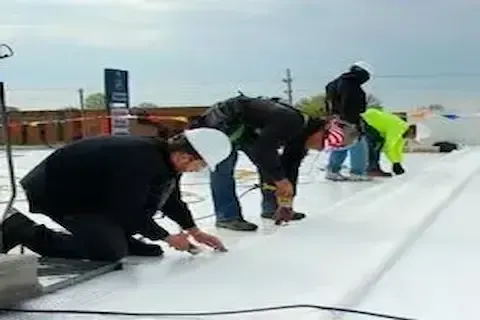
Ponding Water Repair on Coon Rapids Commercial Roofs
Standing water on a flat commercial roof is one of those problems that looks minor until it isn't. A puddle that lingers for two or three days after a rain event signals that your drainage system isn't doing its job — and in Coon Rapids, where spring thaw and summer thunderstorms can dump significant moisture in short windows, that's a condition worth taking seriously. Left unaddressed, ponding water accelerates membrane deterioration, adds structural load, and creates the kind of slow damage that turns a manageable repair into a full replacement project.
Why Ponding Water Happens on Commercial Flat Roofs
Flat roofs are never truly flat — they're designed with a slight slope toward drains, scuppers, or gutters. When ponding develops, it usually means that slope has been compromised or overwhelmed. Several conditions can drive this:
- Settled or deflected decking: Over time, the roof deck can shift or sag slightly under load, creating low spots that trap water.
- Clogged or undersized drains: Debris accumulation, biological growth, and poorly specified drain sizes prevent water from exiting quickly enough.
- Insulation compression: Aged rigid insulation beneath the membrane can compress unevenly, flattening or reversing the designed slope.
- Improper initial installation: Some commercial roofs in Anoka County were installed decades ago without adequate slope engineering, and the problem has compounded since.
Understanding which condition you're dealing with determines which repair approach will actually solve the problem rather than mask it.
The Damage Ponding Water Causes Over Time
The roofing industry standard — set by most major membrane manufacturers — is that water should not pond for more than 48 hours after rain. That threshold exists for good reason. Prolonged standing water degrades TPO, EPDM, and modified bitumen membranes by breaking down seams, softening adhesive bonds, and accelerating UV-related oxidation in the wetted zone.
Beyond membrane wear, ponding adds weight. Water weighs roughly 5.2 pounds per square foot per inch of depth. A 20-by-20-foot low spot holding just two inches of water is carrying over 4,000 pounds of unplanned load. For older commercial structures along Highway 10 or near the Riverdale area, that kind of sustained loading warrants a structural review alongside any roofing repair.
There's also the insulation factor. Water that finds its way under the membrane — through a seam failure or small puncture — saturates rigid insulation and dramatically reduces its R-value. Wet insulation doesn't recover; it has to be replaced.
Repair Methods That Actually Solve the Problem
Effective ponding water repair isn't a single fix — it's a combination of drainage correction and membrane restoration matched to what's actually causing the accumulation.
Tapered Insulation Systems
When the existing roof deck is structurally sound but the slope is inadequate, tapered insulation is often the most efficient solution. Polyisocyanurate (polyiso) tapered panels are cut and layered over the existing substrate to redirect water toward drains. This approach avoids a full tear-off, adds R-value, and corrects slope geometry permanently. For Coon Rapids commercial buildings looking to minimize business disruption, it's a practical and long-lasting option.
Drain Upgrades and Repositioning
Sometimes the drain location simply doesn't align with where water naturally collects. Adding secondary drains, upgrading to larger-diameter drains, or installing overflow scuppers at low points can resolve chronic ponding without needing to alter the entire insulation system. Drain extensions and strainer upgrades also help manage the debris load that Anoka County's tree-heavy landscapes deposit on commercial rooftops every fall.
Membrane Patching and Seam Repair
In areas where ponding has already caused membrane damage — lifted seams, blistered fields, or cracked flashings — targeted patching restores the watertight layer. This is typically done with compatible membrane material heat-welded or chemically bonded to the existing surface. Any repair in a historically wet zone should also include a close inspection of the underlying insulation for moisture content, since resealing over saturated insulation simply delays the next failure.
Identifying the Right Starting Point for Your Building
Before any repair work begins, a proper assessment is essential. Infrared moisture scanning has become a standard diagnostic tool for commercial flat roofs — it identifies wet insulation areas that aren't visible from the surface, allowing repair crews to scope the actual damage rather than guess at it. Core cuts provide confirmation at specific locations.
For property managers and building owners in Coon Rapids, the assessment process should also include a review of the roof's drainage design relative to the building's drainage capacity. A drain that was adequate when the building was constructed may be undersized after additions, HVAC unit installations, or parapet modifications that altered water flow patterns.
If you're dealing with recurring drainage issues and aren't sure where to start, reviewing what commercial roof repair work typically covers can help frame the scope before you bring in a contractor.
Common Mistakes That Make Ponding Worse
One of the most frequent errors in addressing ponding water is applying a coating or sealant over the problem area without correcting the underlying drainage. Elastomeric coatings and liquid membranes can extend roof life when applied correctly, but they don't fill low spots or improve slope — they simply add a fresh layer over a zone that will continue to hold water. Over time, the coating in that area degrades faster than the rest of the roof because it never dries out properly.
Another common mistake is delaying repair until leaks are visible inside the building. Interior water intrusion typically means the membrane has already failed, insulation is compromised, and decking may be affected. At that stage, the repair scope — and cost — is substantially larger than it would have been at the first sign of persistent ponding.
Local Considerations for Coon Rapids Commercial Properties
Coon Rapids experiences a climate that cycles through freeze-thaw conditions multiple times each winter and spring. Water that ponds in late fall can freeze and expand within seams, lifting flashing edges and widening membrane gaps. By the time the building owner notices an issue in spring, the damage from winter ice expansion has already compounded the original drainage problem.
Commercial properties near the Mississippi River corridor and throughout central Anoka County also deal with significant organic debris — leaves, seed pods, and cottonwood fluff that clog drain strainers and reduce flow capacity. Seasonal drain clearing is a simple maintenance step that prevents a large portion of ponding problems before they start.
Addressing drainage issues early is one of the most cost-effective decisions a commercial building owner can make. For buildings in Coon Rapids where flat roof drainage has become a persistent concern, working with a contractor who understands local conditions and offers reliable Commercial Roof Repair is the practical path forward — before a manageable condition becomes a major capital expense.
