Wind Damage Assessment on Coon Rapids Commercial Roofs
When strong winds move through Anoka County, commercial property owners in Coon Rapids often discover damage that isn't obvious from the ground. Flat and low-slope roofs behave differently under wind loading than residential pitched roofs, and the failure patterns can be subtle, progressive, and expensive if they go undetected. A proper wind damage assessment is not a quick visual pass from the parking lot — it's a systematic inspection of uplift zones, edge conditions, fastener integrity, and membrane seams that requires both training and access to the full roof surface.
How Wind Behaves on Flat Commercial Roofs
The aerodynamics of a flat commercial roof create predictable stress zones that every property owner should understand. When wind moves horizontally and strikes a building, it bends upward at the leading edge and creates negative pressure — suction — across the entire roof plane. This uplift force is not uniform. It concentrates heavily at corners and perimeter zones, sometimes generating forces two to three times greater than those at the center field of the roof.
In Coon Rapids, where open commercial corridors along Highway 10 and Foley Boulevard expose rooftops to unobstructed northwest and northwest winds, this uplift concentration is a real operational concern. Buildings with significant footprints, parapet walls of varying heights, or rooftop mechanical equipment that interrupts airflow are all subject to irregular pressure distribution during storm events. Understanding these patterns is the starting point for any credible assessment.
What a Wind Damage Assessment Covers on a Commercial Flat Roof
A thorough assessment moves through several distinct inspection categories. Missing one can leave significant damage undiagnosed until it becomes a leak, a structural concern, or an insurance dispute.
- Edge metal and coping inspection: Edge metal secures the membrane at its most vulnerable termination point. Wind gets underneath lifted or improperly secured edge metal and uses it as a lever to peel back the membrane from the perimeter inward. Coping caps on parapets are another common failure point — when fasteners back out or sealant fails, wind can remove entire cap sections during a single storm event.
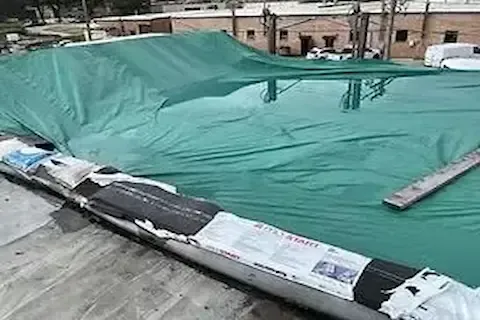
- Membrane uplift and billowing: On TPO and EPDM systems, partially detached membrane sections will billow visibly under wind load but appear flat in calm conditions. An assessor looks for wrinkles, waves, and soft spots that indicate the membrane has separated from the insulation or substrate beneath it.
- Fastener pull-through: Mechanically attached roofing systems rely on fasteners driven through the membrane and insulation into the roof deck. High uplift forces can pull fasteners through the membrane face, creating small punctures that allow water infiltration. These are often invisible unless you're on the roof looking closely at the attachment pattern.
- Seam integrity: Heat-welded or adhesive seams on single-ply membranes can separate under sustained wind loading. Even a seam that holds during the storm may be weakened enough to fail under normal thermal cycling afterward.
- Flashing at penetrations and walls: HVAC curbs, drains, pipes, and wall flashings are all points where wind stress concentrates. Lifted or cracked flashing allows both water entry and continued wind leverage on the membrane edge.
Common Findings on Coon Rapids Commercial Properties After Wind Events
Post-storm inspections across the Coon Rapids commercial district — including properties near the Riverdale area and along Coon Rapids Boulevard — tend to reveal consistent patterns. Edge metal displacement is the most frequent finding, followed by coping cap separation at corners. On older built-up roofing systems, gravel blow-off exposes bare felts to UV and direct rain impact, accelerating deterioration at a pace that makes the next storm significantly more damaging than the first.
Warehouses and big-box retail structures with long uninterrupted roof planes experience significant membrane billowing between fastener rows during high winds. Over time, repeated loading cycles fatigue the attachment points even when no single storm creates visible damage. This cumulative fatigue is frequently underestimated in standard post-storm assessments that only look for acute failures.
For comprehensive help after a storm event, Storm Damage Roof Repair services are specifically structured to address both immediate stabilization and the full scope of documented damage needed for insurance claims.
The Role of Documentation in Commercial Wind Damage Claims
Insurance carriers handling commercial wind damage claims in Minnesota expect documentation that goes beyond photographs of obvious failures. Adjusters reviewing TPO or modified bitumen roof claims will look for evidence that ties observed damage to the wind event rather than pre-existing deterioration. This distinction matters significantly for claim outcomes.
A credible assessment documents the location and pattern of every failure relative to prevailing wind direction, provides fastener pull-through counts per unit area, records edge metal displacement measurements, and notes seam separation lengths with GPS or grid coordinates. Where infrared or probe moisture testing identifies wet insulation beneath an intact membrane surface, that data becomes part of the scope documentation that supports a complete replacement or restoration claim rather than a partial repair allowance.
If you're working through the insurance process and need context on what's typically involved, reviewing storm damage roof repair help can clarify what documentation standards apply to commercial claims in this market.
Timing and Temporary Protection After Wind Events
One of the most consequential decisions a Coon Rapids commercial property owner makes after a wind event is how quickly to authorize temporary protective measures. Exposed membrane sections, open flashing terminations, and displaced edge metal allow water to enter the assembly within hours of a storm. Once water infiltrates the insulation layer, the remediation scope expands substantially — wet insulation cannot be left in place and must be removed and replaced even if the membrane above it appears repairable.
Temporary tarping, emergency sealant application at open seams, and mechanical re-securing of lifted edge metal all limit secondary damage while the full assessment and claim process proceeds. These measures also demonstrate reasonable care, which matters in the event of a coverage dispute with your insurer.
Selecting a Qualified Assessor for Anoka County Commercial Properties
Not every roofing contractor has the training or equipment to conduct a wind damage assessment that holds up to insurance scrutiny. For commercial flat roofing in the Coon Rapids and broader Anoka County area, you want an assessor with documented experience on low-slope systems — TPO, EPDM, modified bitumen, and built-up roofing — who can distinguish storm-induced failures from deterioration-related conditions and produce a written scope with enough specificity to support the claim.
Ask whether the contractor carries errors and omissions coverage, whether they use moisture scanning equipment as part of their assessment process, and whether they have experience working with commercial insurance adjusters on wind damage claims in Minnesota. The answers to those questions tell you more about assessment quality than any general credential.
Wind damage on commercial roofs in Coon Rapids doesn't always announce itself dramatically. What looks like a minor edge displacement after a storm can represent the beginning of a moisture infiltration problem that quietly compromises insulation, deck structure, and interior finishes over the following weeks. A systematic, documented assessment conducted promptly after any significant wind event is the most reliable way to protect both the physical asset and your position in the insurance claim process.
